Hudson: taking the conflict out of shared chores
Nobody wants to be the roommate who nags. Hudson uses a home hub, sensors, and smart reminders to keep chores fair, so people don't have to have that conversation.
Overview
Problem
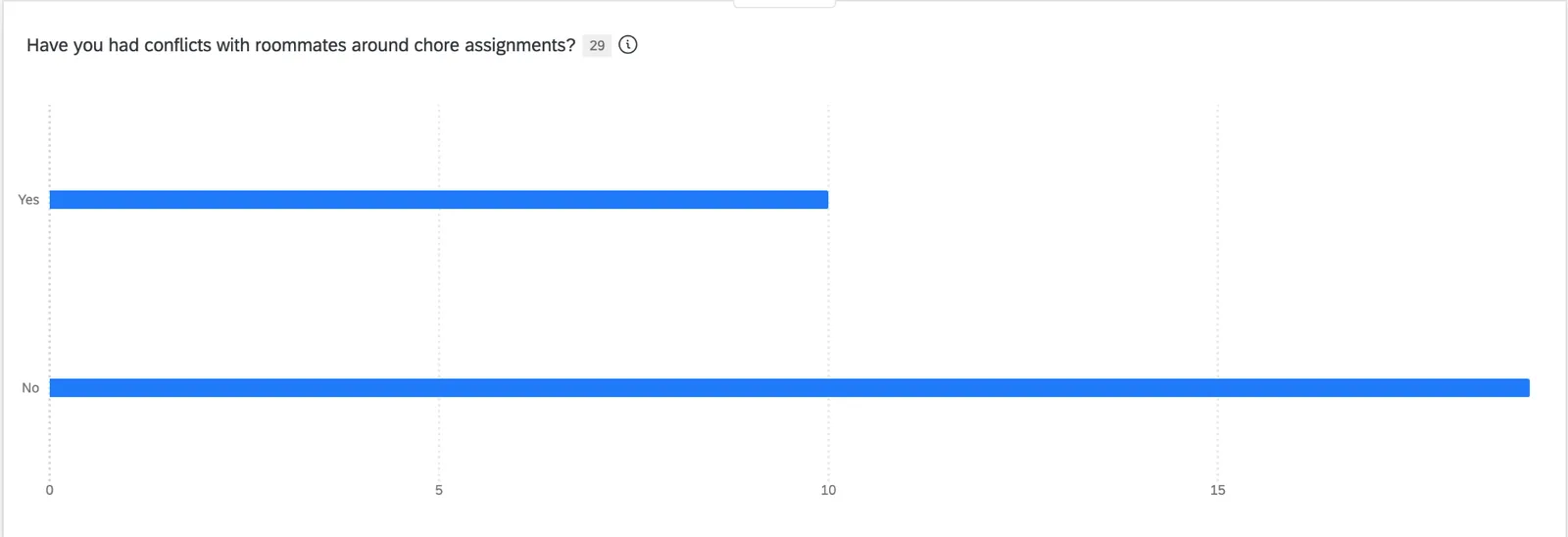
35% of college roommates in our research had conflicts over incomplete chores, largely because nobody wants to confront a roommate about it.
Solution
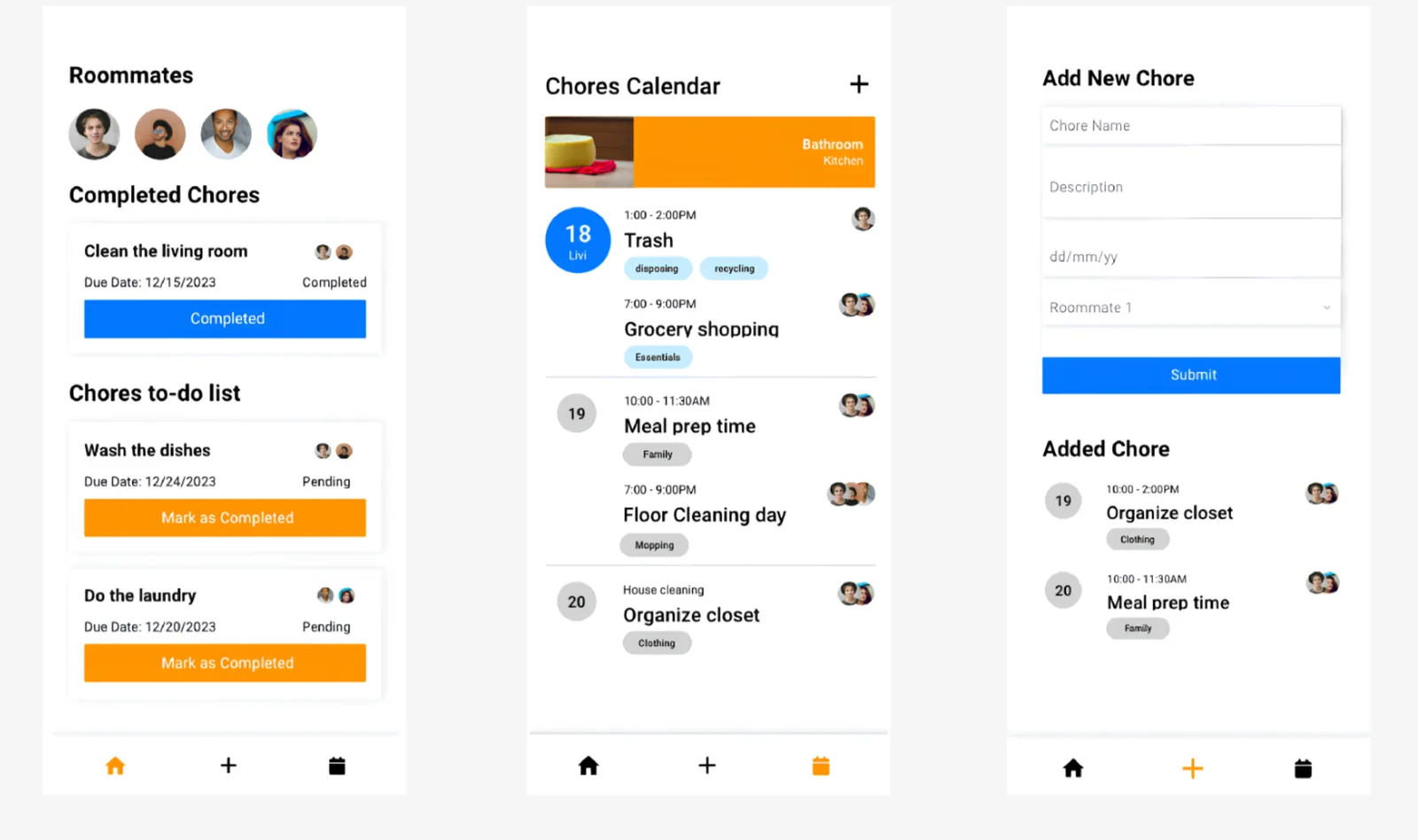
A smart-home system, made up of a hub display, sensors, and a companion app, that assigns chores fairly based on schedules, sends reminders, and verifies when chores are done.
My role
Product designer and UX researcher on a team project, from early concept exploration through research, synthesis, and prototyping.
Outcome
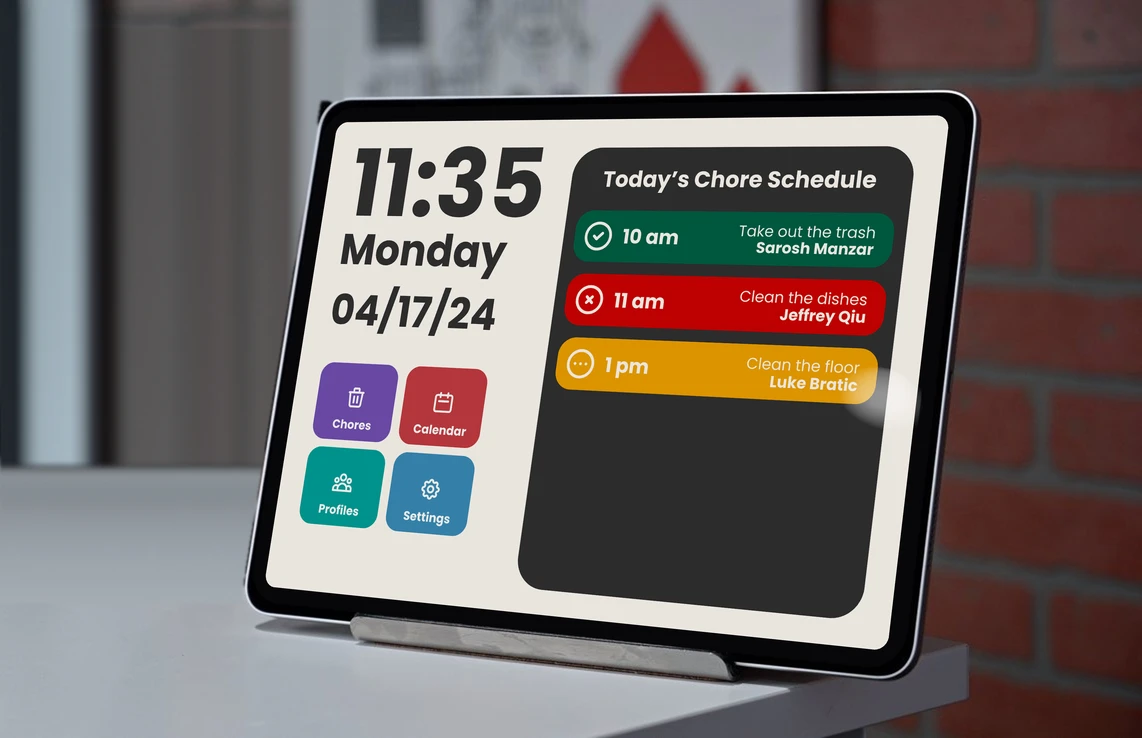
A Figma hub prototype shown on a framed iPad, a companion app design, and two working sensors that detect a full trash can and a full sink.
- Timeline
- January to April 2024
- Team
- Team project
- Methods
- Contextual inquiry, diary study, survey, journey and empathy maps, personas, user enactments, physical prototyping
- Tools
- Figma, Qualtrics
The challenge
35% of college roommates in our research had conflicts over incomplete chores.
The chores themselves weren't the hard part. People avoided bringing up missed tasks because they feared conflict, didn't know how to start the conversation, or had no shared system to point to. The result was predictable: one person quietly picking up most of the work.
How might we help roommates share chores fairly without anyone having to play the enforcer?
Finding the right problem
We started wide. Our team brainstormed 80 ideas for technology woven into everyday spaces, narrowed them through three rounds of voting, and ran contextual inquiries for the top three: checkout-free shopping, productivity for remote workers, and chore management for roommates.
We chose chores because the problem was common, emotionally loaded, and a natural fit for smart-home technology.

Research
A diary study inside real homes
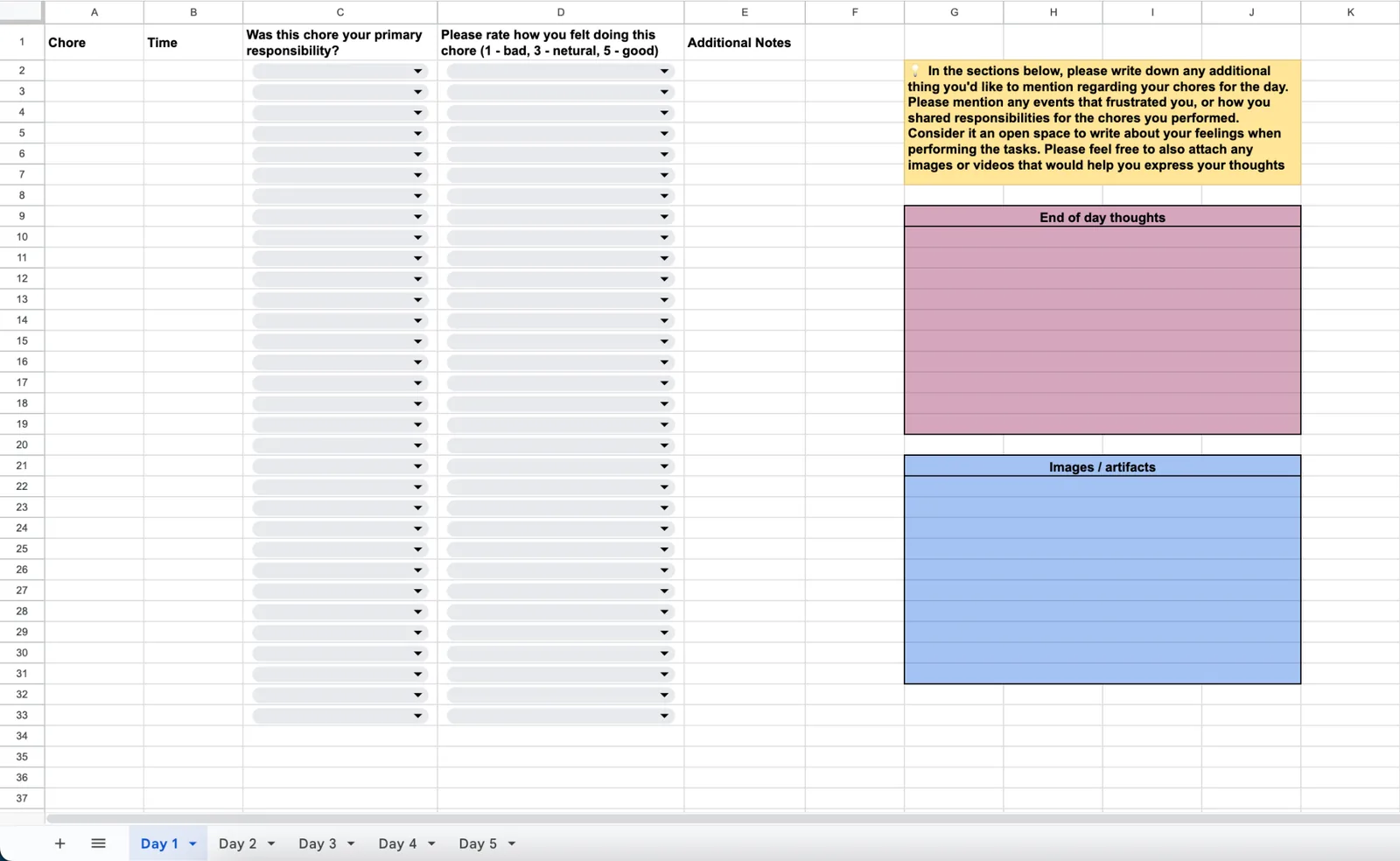
Homes are private, so instead of observing, we asked people to document their own routines. For 5 days, participants logged chores twice a day in a shared spreadsheet: what was assigned, what got done, who did it, and how they felt about it.
A survey for the bigger picture
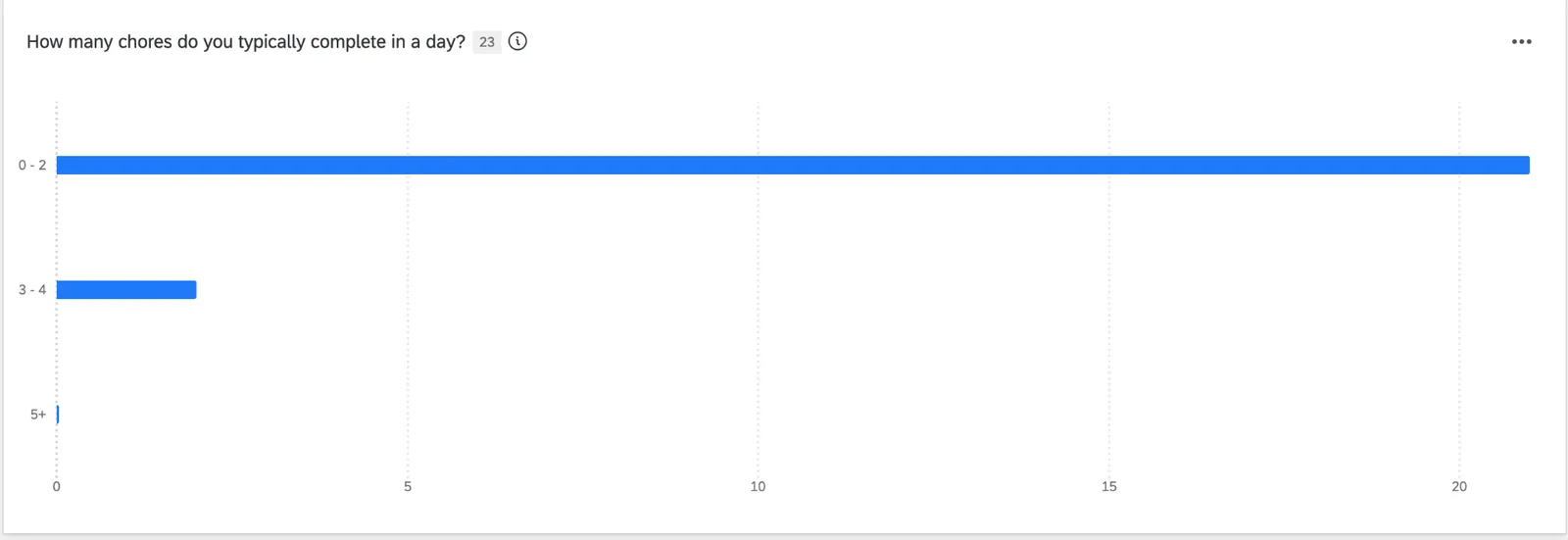
To see whether our diary findings held up more broadly, we ran a 20-question Qualtrics survey through University of Michigan channels, reaching about 30 people ages 22 to 55 who share chores.
What we learned
Households split chores in very different ways
Some people handled their own chores, some households took turns, and many never discussed it at all.
The load is rarely shared evenly
Without a system, one person tends to carry most of the responsibility, which leads to tension and frustration.
Missed chores spread
When someone skips a task, it becomes everyone's problem. Many participants ended up doing other people's chores.
Most households don't track chores
Instead, they rely on verbal check-ins, which often fall apart.
Roommate leaving dishes in the sink annoyed me, making me do dishes twice in one day.
Synthesis
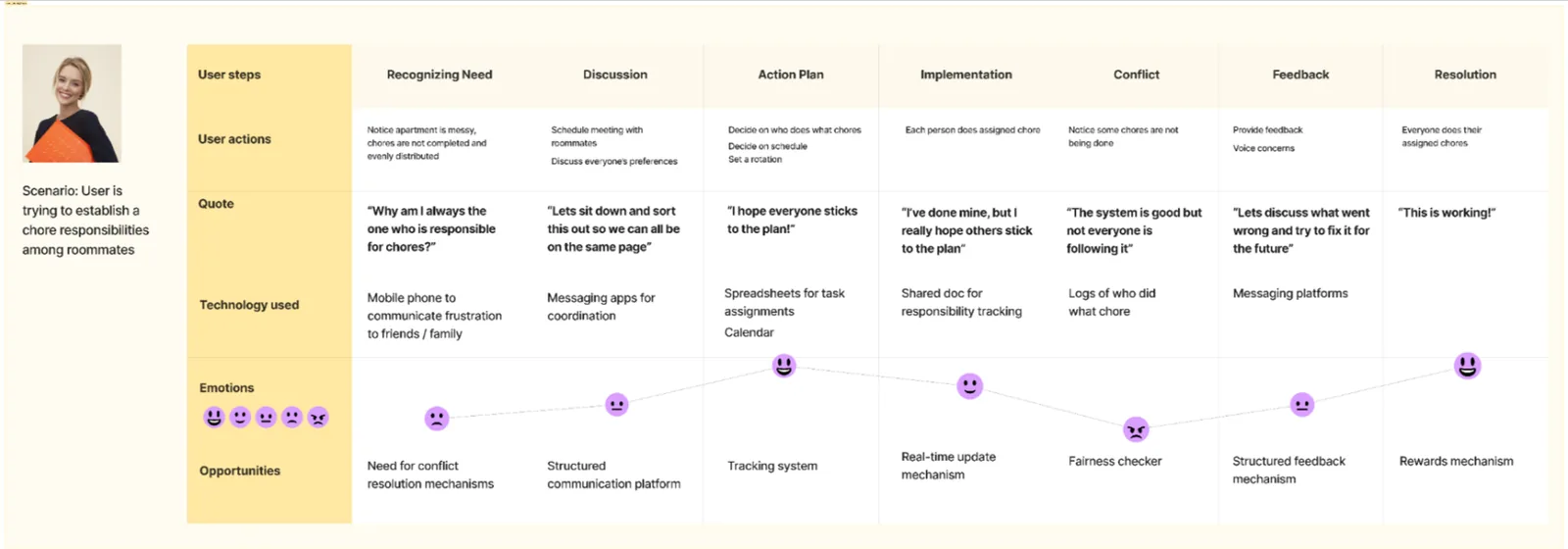
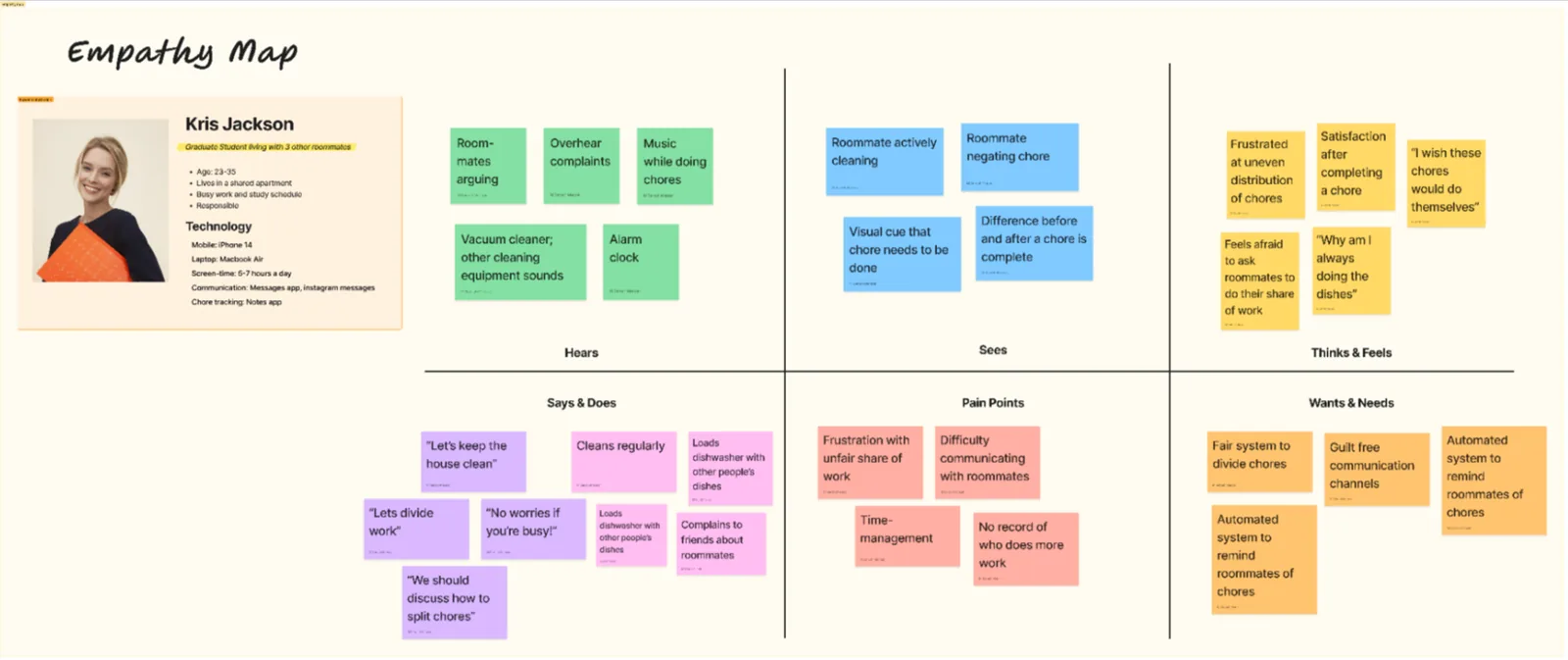
We turned our findings into a journey map, an empathy map, and personas focused on people ages 22 to 35 in shared housing. The journey map made one thing clear: roommates feel anxious about calling out neglected chores, so a neutral third party, like a device, could lower the tension.
The empathy map captured the emotional cycle: hope when someone proposes a new system, then disappointment when it isn't adopted.
Testing ideas with user enactments
Before designing screens, we wanted to know how much a smart home should step in. We ran five user enactments, using props to act out scenarios with people who live with roommates. For planning chores, doing them, and handling conflict, we tested high, medium, and low levels of involvement.
| Stage | High involvement | Low involvement |
|---|---|---|
| Planning | The system moderates chore assignments with on-screen instructions and voice prompts | The system simply records the chores each person enters |
| Doing chores | The display changes and plays a sound when the assigned person walks by | The display shows the assigned person's name and chore |
| Conflict | The system moderates the conflict with instructions and voice prompts | Dim red lights flash on chores that haven't been done |
The enactments showed that people already knew which chores needed doing; the real gaps were motivation, fairness, and accountability. Reminders helped, but anything too aggressive risked embarrassing people in front of their roommates.
Whoever buys the device will probably be the only one who cares. They'll have to lead everything.
Hudson addresses this by handling assignments and reminders itself, so no single roommate has to act as the enforcer.
The solution
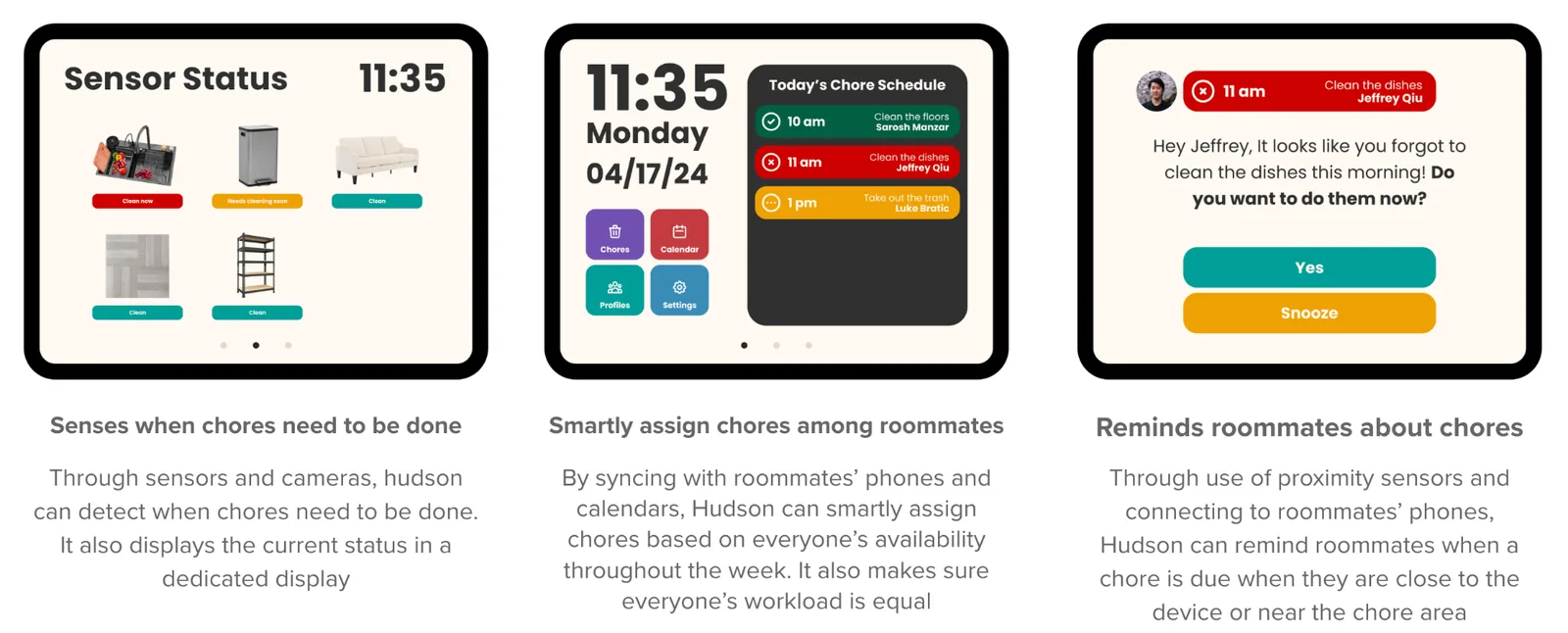
Hudson works quietly in the background of a shared home:
Set up once
Place the hub in a shared space, add sensors near spots like the trash and sink, and sync calendars.
Assign fairly
Hudson assigns chores based on everyone's schedules and preferences.
Remind at the right time
The hub shows each person their chores as they walk by, and reminders arrive as due times approach.
Verify
People check chores off on the hub or app, and sensors confirm them.
Follow up neutrally
Missed chores get flagged with options to reassign or talk it through.
Building the prototype
We built the hub interface in Figma and mounted it on an iPad in a custom frame to simulate how it would look in a real home.
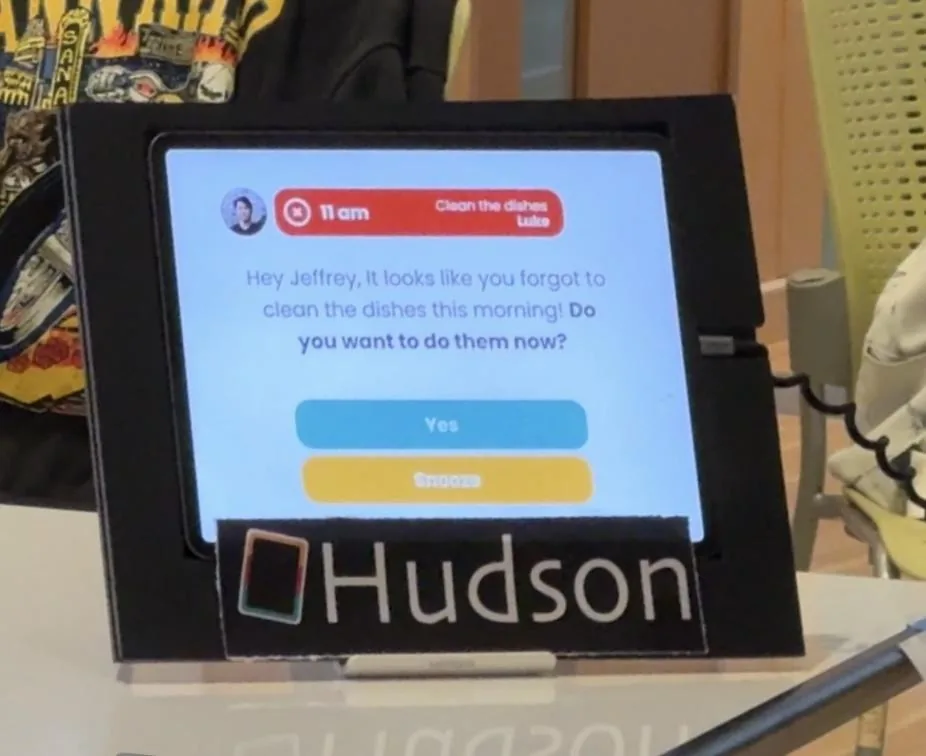
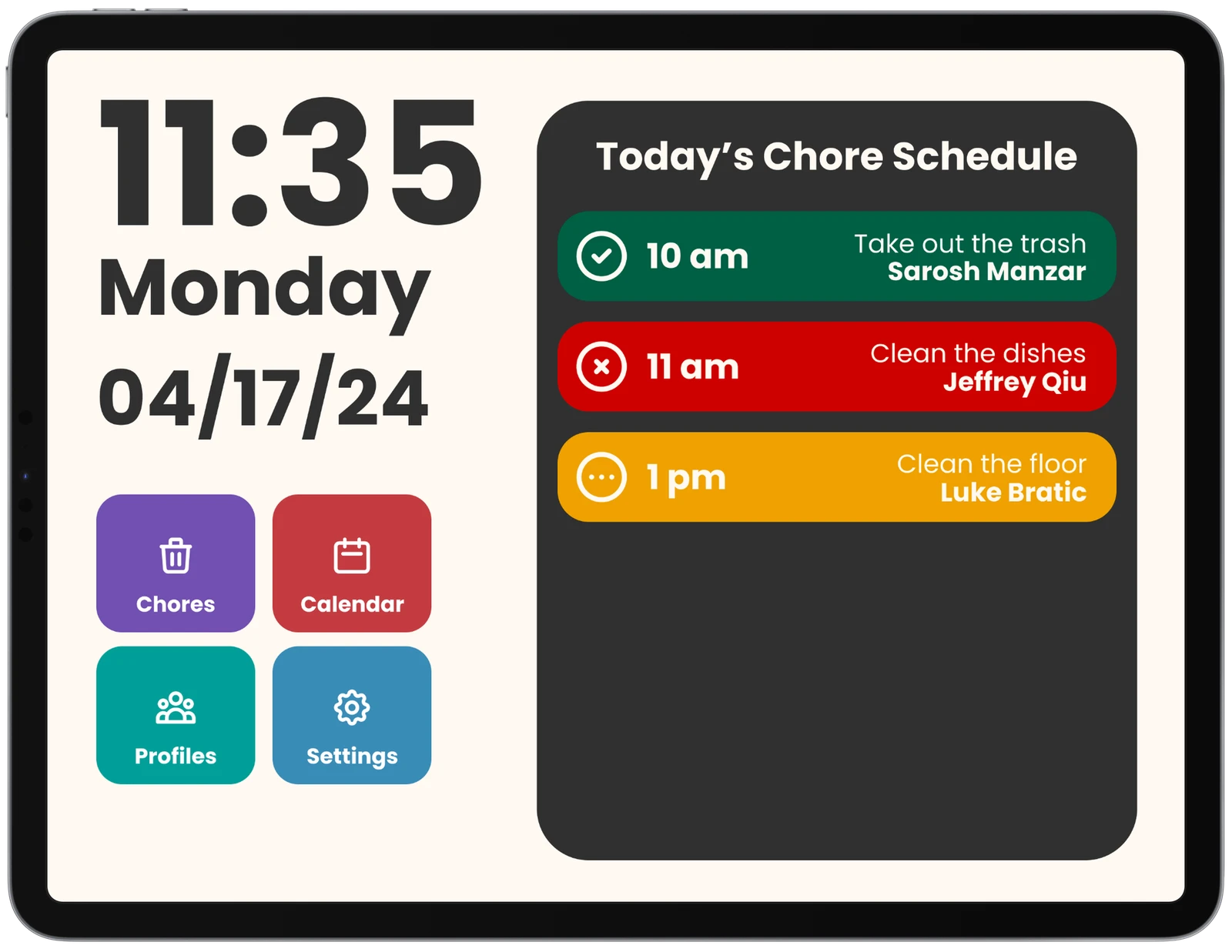
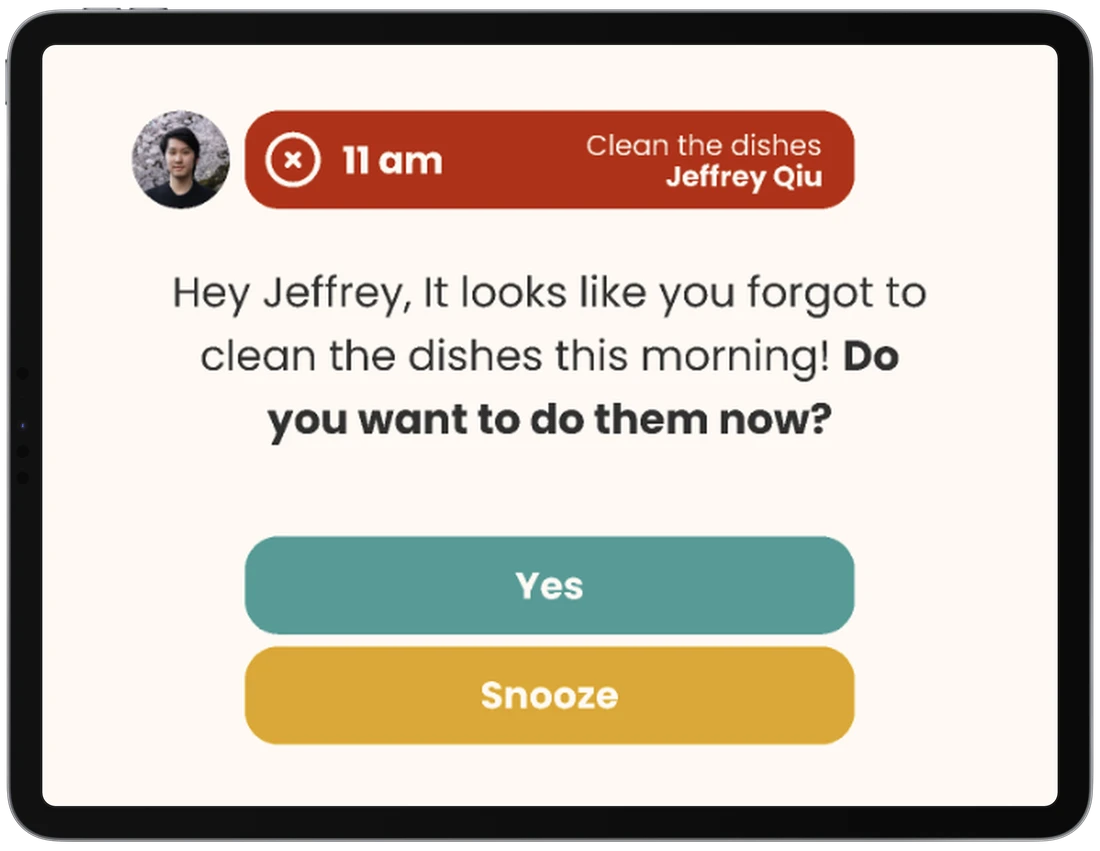
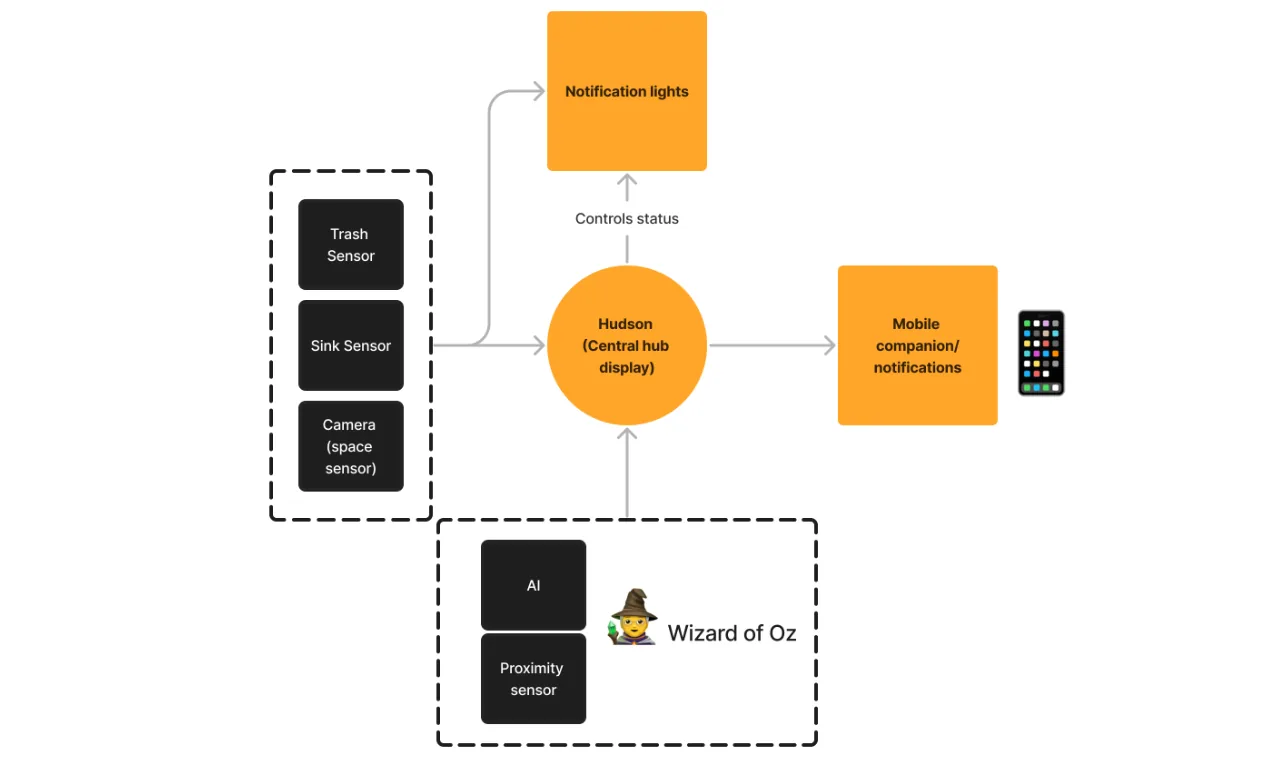
We also built two working sensors. A light sensor inside a trash can turned on a light outside when the can got full, and turned it off once the bag was changed. An ultrasonic range finder over the sink triggered a blinking light when dishes piled up. For AI and proximity detection, we used a Wizard of Oz approach, simulating those features behind the scenes.
Accessibility
Accessibility in this project
Installing cameras and sensors around a home is a real barrier for people with physical disabilities. We identified ways to make Hudson work for more people:
- Simplify installation, or offer setup assistance.
- Support multiple modalities, like visual and audio alerts, for people with physical, visual, or hearing disabilities.
- Make the whole system manageable regardless of physical ability.
Reflection
Hudson taught me that the hardest design problems are often social. Designing reminders that motivate people without embarrassing them mattered as much as the technology behind them.
It also showed me the limits of the concept. Sensors and cameras raise privacy concerns, and if they misjudge a chore, the system could create the unfairness it's meant to fix. Next, I'd expand the survey beyond our first 30 participants and test the system in real homes over time.
An interactive version of this case study, with the full Miro board and prototype, is available on Notion.